|
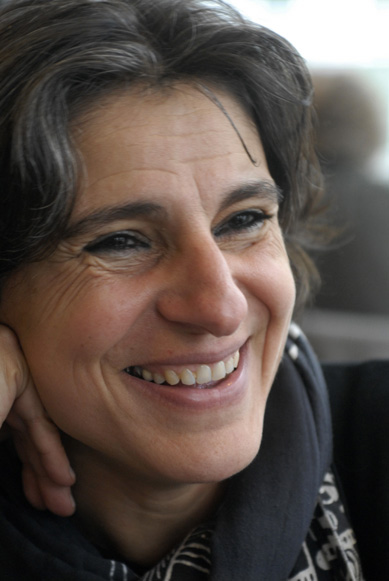
| © Fatou Kandé Senghor |
Mon Travail, Ma Passion, translated from French by Beti Ellerson.
Texte en français ci-dessous
What I enjoy doing…
As a documentarist, I like to observe the changes in society. For us Africans, this transformation occurs in social, cultural, religious and economic contexts that are not very receptive to change but nonetheless, cannot prevent the evolution of humanity. Some of my documentaries have struck me by their sense of continuity, for instance the recent film, Rafet Car. In 2000, accompanied by contemporary poets from around the world, I made a road movie of sorts. We traveled 2500 km from the island of Gorée to the city of Timbuktu, making a stopover at the mythical cities of the ancient empire of Mali. We traveled for three weeks by train, bus, and pirogue on a path once taken by the ancient caravaners in search of traces of poetry, stories and legends recorded in the oral tradition. The film Tara, chemins de la parole transported me into the past, into grand spaces, into the lives of the "others", revealing how people at the crossroads combined the practices of traditional and modern life.
Then there was Diola Tigi
The film Diola Tigi is a look within based on the question: "What is a Diola?" even before entering the landscape. Set in the village of Baïla, where the initiation ceremony Bukut takes place every thirty years, this journey inside the Diola society leads us into the sacred grove, a cultural and religious rampart that allows the Diola to resist the excesses of modernization. A feast which include charms, euphoric beverages, libations, alongside the practices of bullying and competitions of invulnerability using knives and machetes. An opportunity for me to converse with the Diola sages, the gatekeepers of tradition who are concerned about a changing generation that is no longer familiar with the great moments of initiation and is not sufficiently rooted to receive the secrets of the sacred; a real dilemma in Africa today.
Then I encounter the giant of Senegalese painting. Gripped by alcoholism, married to a popular Senegalese actress, he is split between moments of total sobriety and passion for his family and those interludes with Bacchus, turning into an imp, abandoning the trait that made him the great painter Jacob Yacouba, before the eternal. The film, The Return of the Elephant is the portrait of this man of the arts through which a chapter of our art history is revealed. A great era lived in splendor and creativity, and especially encouraged by President-poet Senghor. Great artists came from Europe to Senegal to exhibit at the National Gallery, notably Picasso, Fernand Leger; a sign that African artists have finally entered the world arena. It is within this context that the painter Jacob Yacouba recounts to us a love story, a story of painting, the story of a somewhat spoiled generation; a rather racy, personal and ultimately sad story.
In True School I watch the Senegalese youth as they come and go to Université Cheikh Anta Diop, I feel the pulse of our fledgling intellectuals soon to be called upon to lead our country. Local rap is part of their everyday experience. Then I immerse myself in their lives, their neighborhoods, leading me to the outskirts of Dakar in the underprivileged quarters, where their neighbors, whose music they consume, live and who without a doubt, can directly relate to the subject of their songs. In this same neighborhood, there is a concert that evening. Hip hop concerts are like evening political rallies. And often these “underground” concerts end up with stones thrown at the police by fans who also break out in fights as the rappers try to calm the public in order to continue the entertainment, and the peace—even though the lyrics of their songs denounce the politics that inflame the masses. It is not every day that we have the privilege to share with these same young people who are perceived as objectionable, who have no recourse, and who, nonetheless, in 2000 contributed to the change of power in the government. And yet, they have since been disappointed, even disillusioned, by those they elected. A film that may be used to assess the 10 years of hip hop music in Senegal that has been very critical of the social, political and economic situation.
Doomireew, "sons of the country" is probably my favorite film because it is the story of our mentors, of those who gave us our personality, this same personality that allowed us to tell stories through films. Doomireew is the story of three men: One was called Abdoulaye Douta Seck, the other Ousmane Sembene and the third Aimé Cesaire. They lived the radiance of their passion, one on the stage, in front of the camera, the other, pen in hand, an eye behind the camera, and the latter by his intelligence, creativity and faith in his people. They experienced the glory of their hard work and though leaving the scene with faltering health, had enough years of life to see Africa, Africans and the world from every angle. How lucky! Their teachings were nestled in their work, their personalities—meticulous and intense, their splendid gestures, their genius, their distinction, the resoluteness in their choices and their conviction—never revoking their beliefs—and their eloquence, their sincerity.
Again immersing myself in unique places—probably the main motivation of all documentarists—to observe while at the same time being accepted by others. This is my constant quest. For the film All Roads Lead to Rufisque, I penetrate the world of Senegalese women prisoners. I make my way into the Rufisque prison—in these cramped, barely lit spaces, where I meet women from the countryside, abandoned by their families to live among themselves, struggling to adapt to the changes of modern life. In order to better understand the functioning of a social system, I investigate why these Senegalese women land in prison. The bars, rusty, chained grills, and the faces of young women, like characters in a novel. What could they have done to be here, all of these women? What were their crimes, their dramas, their heartrending experiences? A woman’s obedience to men and elders constitute the core principle of our education, even determining a woman’s fate. How are their crimes possible in a society based on the subjugation of women, irrespective of ethnic group? As early as female puberty, her laughter, her manner of walking and her innocence are captured, confined, shaped, and framed to be married. The education of a girl is so meticulous and rigorous in this micro-power called family, that I wondered how a Senegalese woman could transgress the law and end up in jail. Then suddenly I meet a very particular prisoner. A Lebanese woman with her older sister—imprisoned for 10 years. The eldest sister, an almost ordinary prisoner besides her milky skin, adapted herself to the environment to better pass away the time and survive, I suppose; while the other, very intriguing, constantly writes; nobody dares touch her belongings or come near her. It was through my encounter with the famous Senegalese writer Boubacar Boris Diop that I was able to grasp the reality of women prisoners and to meet them. He taught philosophy at Rufisque for seven years and was the advisor to this intriguing young woman. Through their strolls and chats together we traversed the labyrinth of prison life. I mention her "because it will be a film bigger than me." I follow wherever she leads me; I will call her Marie Madeleine. She will make the connection between all the other main characters under the assumed names of: Khoudia, Awa, Aminta and Sira, all incarcerated respectively, for infanticide, illegal prostitution, drug trafficking, and assault and battery. Their stories are poignant, reflecting the uneasiness of those who fled their villages to live in the capital, torn between tradition and modernity. And this extraordinary encounter with this young woman is almost a miracle as we young Senegalese have attempted to unravel the mysteries of the Lebanese community that blends so well into our own and at the same time who, we know very well, despise us.
So, Rafet Car. Why a film on feminism in Africa?
How could one live in the Dakarois capital everyday without noticing at five o'clock in the morning the faces of its women, walking the streets, engulfed in all sorts of public transportation—public utility cars and sanitary trucks—these women who work hard to provide for their offspring, with loads on their head, baby on their back, while their own domestic and marital duties await their return home. And how could one ignore all the invasive tabloid headlines recounting rapes, kidnappings, sequestrations, violence done to girls, women, mothers? The humorous treatment of cartoonists on the condition of women is of bad taste or rather of a total ignorance of their real condition. How can I ignore the textbooks of my daughters where there are no female role models to which we may refer, and women holding only secondary roles, leaving the responses for the boys and men. So the question is, what is being done about this situation here in my country, Senegal, which is known to have ratified all the laws, all the conventions protecting human rights? What are the demands of these women? Who are the protesters? Where is the fight, if it exists? When probing into our women’s stories, I was not surprised at their lack of knowledge about their rights, due to illiteracy, fundamentalism, and tradition. And thus, inevitably feminism is still very much alive as the demands are even more vivid today despite the impression that laws have resolved many of the problems of Senegalese women and men. I, Fatou Kandé Senghor am a feminist. Admittedly, I am not part of any association, but I live it with each breath that I take, in my everyday existence. It has always been a part of me. Since very young I battled with my parents—to live and do interesting things, to study, to not be like the women in my house, but to take all that life could offer me.
I am familiar with the feminisms of the world. I have observed very well European feminists, American feminists, who have their own specificities. Often they have misunderstood us because our upbringing, our reactions are not quite in agreement with their beliefs and ideas, which proclaim: "neither whores nor doormats". But fortunately on the African continent where we have chosen to return, we can read in the actions of many of the prominent women of our society, our beliefs and values. This film is necessary to initiate a discussion in Senegal, an honest discussion about what feminism is among us, a feminism that has its detractors but also its issues within the movement.
MON TRAVAIL, MA PASSION
24 décembre 2009
CE QUE J’AIME FAIRE…
En tant que documentariste, j’aime observer les mutations de la société. Chez nous les africains, ces mutations s’opèrent dans des contextes sociaux, culturels, religieux et économiques qui sont peu ou pas réceptifs aux changements et qui néanmoins ne peuvent pas empêcher les êtres humains de traverser le temps. Quelques uns de mes documentaires m’ont marqués par une sorte de continuité et ce film RAFET CAR le dernier en date vient s’inscrire sur la liste de ceux dont je vais vous parler. En 2000 j’ai réalisé un film qui était un voyage par la route, en compagnie de poètes contemporains venus des quatre coins du monde. Nous avons parcourus 2500 km en partant de l’île de Gorée jusqu’à la ville de Tombouctou et en faisant escale dans les villes mythiques de l’ancien empire du Mali. Nous avons voyagé pendant trois semaines en train, en bus, en pinasse sur ce chemin jadis emprunté par les caravaniers pour retrouver les traces de poésie, de contes et de légendes consignées par la tradition orale. Ce film intitulé « TARA, les chemins de la parole » m’avais transposée dans le passé, les grands espaces, la vie des « autres » et révélé comment les peuples croisés en chemin alliaient les pratiques de la vie traditionnelle et celles de la vie moderne.
Puis il y a eu DIOLA TIGI
Le film Diola tigi est un regard intérieur qui s’appuie sur un questionnement : « Qu’est ce qu’un Diola ? » avant même que de pénétrer dans le terroir. Ce voyage à l’intérieur de la société diola a pour cadre le village de Baïla où se déroule tous les trente ans, la cérémonie d’initiation : le Bukut, une immersion dans le bois sacré, un rempart culturel et cultuel qui permet au diola de résister à un excès de modernisation. Une fête à laquelle sont conviés gris-gris, boissons euphorisantes, libations, brimades, compétition d’invulnérabilité avec des couteaux et des machettes. Une opportunité pour moi de parler avec les sages diolas, gardien de la tradition qui sont soucieux de cette jeunesse qui change et qui ne connait plus les grands moments initiatiques et qui n’est pas assez ancré pour recevoir les secrets du sacré.Tout le dilemme de l’Afrique.
Puis je rencontre ce monstre sacré de la peinture en proie à son alcoolisme, marié à une actrice populaire sénégalaise sous le feu des rampes et qui vit un déchirement total entre ses moments de sobriété et de passion pour sa famille et ses moments avec bacchus, quand il se transforme en diablotin abandonné par le trait qui a fait de lui jacob yacouba grand peintre devant l’eternel. Le film s’intitule LE RETOUR DE L’ELEPHANTet c’est à travers le portrait de cet homme d’art qu’un pan de notre histoire de l’art se dévoile. Une grande époque vécue dans le faste et la créativité et surtout encouragée par le président poète Senghor. Les grands artistes de l’Europe viennent au Sénégal exposer à la galerie Nationale, PICASSO, Fernand LEGER, signe que les artistes africains sont enfin entrés dans l’arène mondiale. C’est dans ce contexte que le peintre Jacob yacouba nous raconte une histoire d’amour, une histoire de peinture, l’histoire d’une génération un peu gâtée et une histoire personnelle piquante et triste finalement.
Dans « TRUE SCHOOL » : J’ai observé la jeunesse sénégalaise dans son va et viens vers l’université Cheikh Anta Diop, j’ai taté son pouls à travers nos graines d’intellectuels appelés à diriger notre pays. Et dans leur vie de tous les jours, il y a le RAP local. Puis j’ai immerge avec eux dans leurs quartiers. Cela m’a conduit dans la banlieue populaire Dakaroise où les auteurs de la musique qu’ils consomment sont leurs voisins et forcément touchent à tous leurs problèmes dans leurs paroles. Et dans leurs quartiers, le soir, il y a concert. Les concerts de hip hop sont comme des rassemblements politiques nocturnes. Et souvent ces concerts « underground » se terminent par des jets de pierres contre les forces de l’ordre, où des bagarres éclatent parmi les fans, alors que les rappeurs tentent de calmer le public pour continuer la fête et la paix, même si ce sont les paroles de leurs chansons dénonçant la vie politique qui embrasent les foules. Ce n’est pas tous les jours que l’on a le privilège de partager cela avec une jeunesse que l’on a dit malsaine et qui n’a plus d’issues de secours et qui a tout de même contribué à changer le pouvoir en place en 2000 et qui a déchanté depuis lors déçue par ceux qu’elle a élu. Un autre film casse-tête qui attend 2010 pour évaluer 10 ans de musique hip hop sénégalaise très critique de la situation sociale, politique et économique.
« DOOMIREEW, fils du pays » est probablement le film que je préfère parce que c’est l’histoire de nos mentors, de ceux qui nous ont donné une personnalité, celle là même qui nous a fait choisir de raconter des histoires à travers les films. Doomireew, c’est l’histoire de trois hommes : L’un se nommait ABDOULAYE DOUTA SECK, l’autre OUSMANE SEMBENE et le troisième AIME CESAIRE. Ils avaient vécu le rayonnement de leur passion, l’un sur les planches et devant l’objectif des caméras, l’autre la plume à la main et l’œil derrière la caméra et le dernier par son intelligence, sa créativité et sa foi en son peuple. Ils ont vécu la gloire de leur dur labeur et une sortie de scène avec une santé vacillante mais avec assez d’année de vie pour voir l’Afrique, les Africains et le monde sous toutes leurs coutures. Quelle chance. Leurs enseignements étaient tapis dans leurs œuvres, leurs personnalités rigoureuses et limite exécrables, leurs gestes fastes, leurs génies, leurs discernements, leur fermeté dans leurs choix et dans leurs convictions, leurs vestes jamais retournées, leur éloquence, leurs vérités.
Et à nouveau, l’immersion dans des lieux uniques, c’est probablement cela la motivation principale de tout documentariste. Observer tout en étant accepté par les autres. C’est cela ma quête constante. Pour le film TOUS LES CHEMINS MENENT A RUFISQUE, J’entreprends donc l’immersion dans un lieu unique : L’univers carcéral de femmes sénégalaises. Je me suis immergée, dans la prison de Rufisque, dans ces lieux exigus, à peine éclairés, où j’ai rencontré des femmes originaires de la campagne, abandonnées à elles mêmes par leur famille et qui vivent encore difficilement les mutations de la vie moderne. Pour mieux comprendre le fonctionnement d’un système social, je cherche à savoir pourquoi les femmes sénégalaises atterrissent en prison. Les barreaux, les grilles rouillées enchaînées et les visages des jeunes femmes telles des personnages de roman. Que pouvaient-elles bien faire là toutes ces femmes ? Quels étaient leurs crimes, leurs drames, leurs déchirements ? Les vertus de l’obéissance aux hommes et aux aînés constituant les principes essentiels de notre éducation, déterminant même le devenir d’une femme. Comment le crime était-il possible au sein d’une société qui repose sur la soumission des femmes, toutes ethnies confondues ? En effet dès la puberté des filles, ses rires, ses promenades et son innocence sont capturés, limités, modelés, encadrés puis mariés. L’éducation d’une fille est tellement méticuleuse et rigoureuse dans ce micro pouvoir qu’est la famille que je me suis demandé comment la femme sénégalaise pouvait transgresser la loi et se retrouver en prison.Puis tout à coup je rencontre une détenue bien particulière. Une libanaise avec sa sœur aînée, incarcérée pour 10 ans. La sœur aînée est une prisonnière presque ordinaire au-delà de sa peau laiteuse, elle a adopté le milieu pour mieux voir le temps passer et survivre, je suppose, tandis que l’autre qui écrit tout le temps et dont personne ne touche les affaires ou ne l’approche, est très intrigante. Pour saisir la réalité des femmes détenues et les rencontrer, ce sera finalement un célèbre auteur sénégalais BOUBACAR BORIS DIOP qui a enseigné la philosophie à Rufisque pendant 7 ans qui sera le conseiller à la vie de cette jeune femme intrigante et ce sera à travers leurs promenades et leurs échanges que nous serons menés dans les labyrinthes de la vie carcérale. Je la cite « parce que ce sera un film plus grand que moi ». Je la suis aveuglément et la nomme MARIE MADELEINE. C’est elle qui fera le lien entre toutes les autres personnages principales dont les noms d’emprunts sont : Khoudia, Awa, Aminta et sira toutes incarcérées respectivement pour infanticide, prostitution illégale, trafic de drogue et coups et blessures volontaires. Leurs histoires sont poignantes et reflètent le malaise de celles qui ont fui leurs villages pour vivre à la capitale, déchirées entre deux modes de vie : traditionnelle et moderne. Et puis, cette rencontre exceptionnelle avec cette jeune femme reste presque un miracle tant nous jeunes sénégalais avons tenté de percer les mystères de cette communauté libanaise qui se fond si bien dans la notre et qui en même temps sait si bien nous maîpriser.
ALORS RAFET CAR, POURQUOI UN FILM SUR LE FEMINISME EN AFRIQUE ?
Comment pourrait t’on vivre dans la capitale dakaroise sans remarquer au quotidien ses visages de femmes dès cinq heures du matin qui arpentent les rues, s’engouffrent dans toutes sorte de transport en commun, de services publics et sanitaires, ces femmes qui travaillent d’arrache pied pour subvenir aux besoins de leurs progénitures charges sur la tête, bébé au dos tandis que les tâches ménagères et conjugales attendent leurs retour au domicile. Et comment ignorer tous les tabloids envahissants dont les grands titres relatent viols, sequestrations, coups, enlèvements, violences faites à des fillettes, des femmes, des mères. Le traitement humouristique des caricaturistes de la condition de la femme est d’un mauvais goût ou plutôt d’une ignorance totale de leur condition réèlle. Comment puis je fermer les yeux sur les manuels scolaires de mes filles dans lesquels il n’y a aucuns modèles féminins, sur lesquels on peut se référer, et les femmes y occupent uniquement des rôles secondaires donnant la réplique à des petits garçons, et à des hommes. Alors la question revient , qu’est ce qui est fait pour cette situation là, dans mon pays le Sénégal qui est connu pour ratifier toutes les lois, toutes les conventions qui protègent les droits des humains. Quelles sont les revendications de ces femmes et qui en sont les porteurs et où en est ce combat s’il existe. En plongeant le nez dans les histoires de nos femmes, quelle ne fut pas ma surprise sur la méconnaissance des droits des uns et des autres à cause de l’analphabétisme, à cause du fondamentalisme religieux, à cause de la tradition, alors forcément le féminisme existe encore bel et bien, car les revendications sont encore plus vives aujourd’hui alors que l’on a l’impression que la loi a réglé tellement de choses pour les sénégalais et sénégalaises que nous sommes. Et puis un constat majeur dans ma vie, Je suis une féministe, moi Fatou Kandé Senghor. Je ne milite dans aucune association, certes, mais je le vis a chaque bouffée d’air inhalée tout naturellement et dans ma vie, et ce depuis toujours. La bataille dans le domicile parentale si jeune pour vivre et faire des choses interressantes, pour aller étudier , pour ne pas ressembler aux femmes de ma maison et pour prendre tout ce que la vie aurait à m’offrir. Le féminisme dans le monde, je le connais, je l’ai bien observé, les féministes européennes, américaines ont leur trajectoire particulier et souvent elles nous ont montré beaucoup de mépris parce que nos éducations nos reflexes était pas tout à fait en accord avec les préceptes de leur concept de l’époque « ni putes, ni soumises ». Mais heureusement sur le continent africain où nous avions choisi de rentrer nous pouvions lire les signes de nos convictions chez beaucoup de femmes au devant de la scène. Ce film il est nécessaire, pour amorcer une discussion dans ce Sénégal, une discussion honnête sur ce féminisme de chez nous qui a ses détracteurs mais qui a aussi des problèmes internes au mouvement.
Published by permission from Facebook Page.